


When Should You Replace Your Car Tyres? 5 Signs It’s Time for New Tyres
When people ask, “When should I replace my car tyres?”, the most common answers are often “every 50,000 kilometres” or “every 2 years”. Neither is completely correct. Tyres do not deteriorate according to the odometer alone. Their actual condition matters more.
Two cars with the same mileage may need tyre replacement a year apart. It depends on tyre pressure, road conditions, driving habits, and even where the car is parked.
In this article, the technician teams at K. Charoen Yangyont and K. Charoen Cockpit will show you 5 signs that indicate when your tyres need replacing. We will also explain how to check them yourself in just three minutes. This can help you avoid replacing tyres too early or continuing to use them for too long.
When Should You Replace Your Car Tyres? Quick Summary
Replace your tyres immediately if you notice any of the following:
- The tread has worn down to the tread wear indicators, at around 1.6 mm
- The sidewall is bulging, swollen, or deeply cut enough to expose the internal cords
- There are clear cracks on the tyre sidewall
Plan to replace your tyres soon if you notice any of the following:
- The tread depth is below 3 mm, especially before the rainy season
- The tyres are 5–6 years old from the date of manufacture, even if there is still tread remaining
- The tread is wearing unevenly, or the vehicle has unusual vibration, pulling, or noise
Tyres should not be used for more than 10 years from the date of manufacture, even if they still look almost new.
5 Signs That It’s Time to Replace Your Tyres
Sign 1: The Tread Has Worn Down to the Tread Wear Indicator
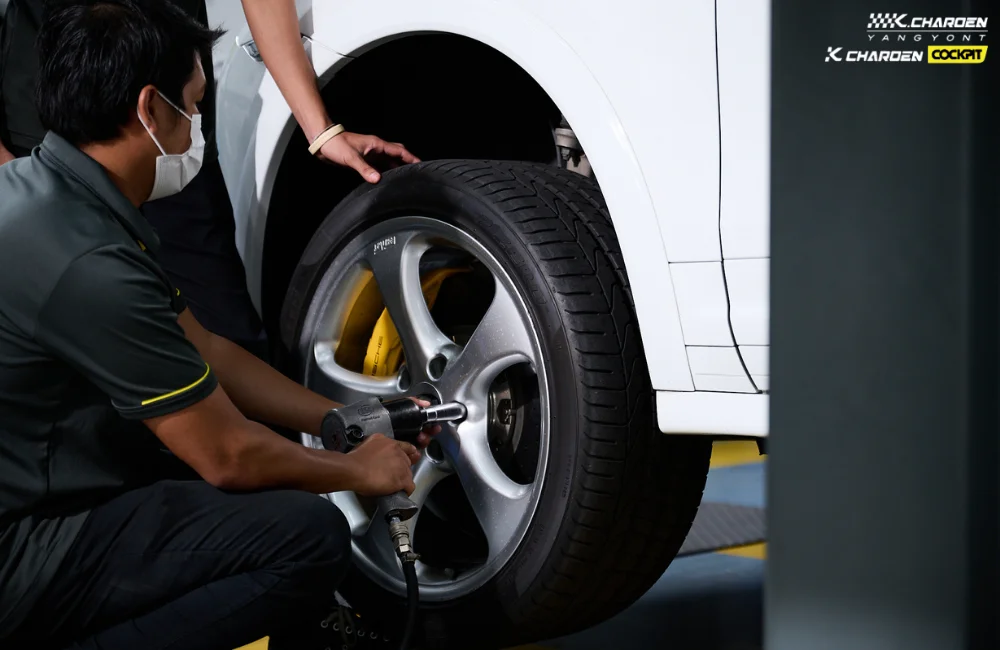
A TWI (Tread Wear Indicator) is a small raised bar built into the bottom of the tread grooves. All tyre manufacturers include these indicators from the factory. Look for a small triangle on the tyre sidewall, then follow it across the tread groove to find the indicator.
- If the tread surface is level with the tread wear indicator, the tread depth is around 1.6 mm. This is the minimum acceptable level under international standards, and the tyre should be replaced immediately.
- However, you should not wait until this point. At 1.6 mm, the tyre’s ability to disperse water has already been significantly reduced. On wet roads at high speeds, the risk of aquaplaning is much higher.
Technician’s Recommendation: Thailand experiences rain for much of the year. If you often drive long distances or the rainy season is approaching, consider replacing your tyres when the tread depth reaches around 3–4 mm. There is no need to wait until the tread reaches the wear indicator. On wet roads, even a few metres of braking distance can make the difference between stopping in time and not stopping in time.
How to Measure Tread Depth Yourself
- Use a tread depth gauge. It costs only a few hundred baht and provides the most accurate measurement.
- Measure at least 3 points on each tyre: the inner edge, centre, and outer edge. Use the lowest reading.
- If you do not have a gauge, use the tread wear indicator as your main reference. A coin test can provide only a rough estimate and is not accurate enough for making a replacement decision.
Read more about tyre structure and components to understand where the tread wear indicator is located.
Sign 2: Cracked Sidewalls or Rubber That Has Hardened with Age
This is one of the most commonly overlooked signs because the tyre may still look fine. In reality, tyres deteriorate through chemical reactions between the rubber compound and oxygen, ozone, heat, and sunlight. This process continues even when the vehicle is parked.
As the tyre ages, the rubber becomes harder and less flexible. Grip also decreases, and small cracks may begin to appear on the sidewall or at the base of the tread grooves. These are commonly known as age-related cracking.
Practical Guidelines
- At 5–6 years from the date of manufacture, you should start planning for replacement, even if around half of the tread remains.
- Tyres over 10 years old should not be used, no matter how new they may look.
- If clear cracks begin to appear on the sidewall, replace the tyre immediately because this can indicate that the structure is starting to deteriorate.
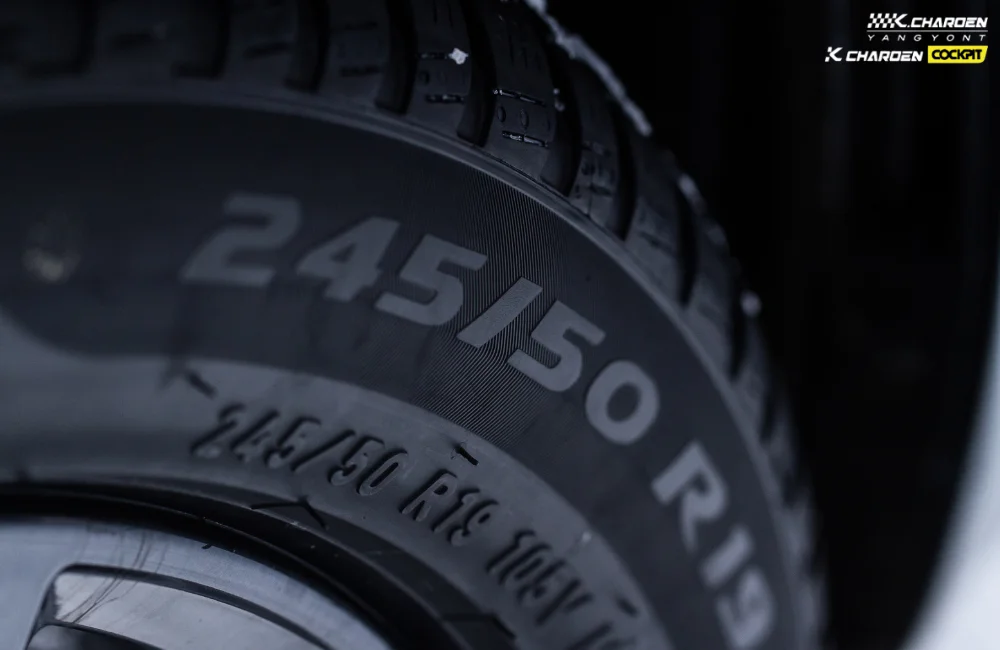
How to Read the Tyre Manufacturing Date: Look for a 4-digit number inside an oval on the tyre sidewall. For example, 2521 means the tyre was manufactured in the 25th week of 2021. This means that in 2026, the tyre is already 5 years old and it is time to start planning for replacement.
Sign 3: A Bulging Tyre, Swelling, or Deep Cuts
If you notice a bulge on the tyre sidewall, stop using the vehicle immediately. Take the vehicle to a tyre shop at low speed or call for roadside assistance.
A bulging tyre occurs when the internal structural cords are damaged. Air pressure then pushes the rubber outward and creates a visible bulge. Common causes include hitting a pothole hard, scraping against a kerb, or driving with tyre pressure that is too low.
Important: A bulging tyre cannot be repaired or patched. There is also no way to know when it may fail. A tyre with a bulge has a very high risk of bursting at high speed, which can be life-threatening.
The same applies to deep sidewall cuts that expose the internal cords, or tread cuts wider than 6 mm. These types of damage cannot be repaired and the tyre must be replaced.
Sign 4: Uneven Tread Wear
A tyre that wears evenly across the tread is generally working as it should. If the wear is uneven, it may indicate another problem with the vehicle. Replacing the tyre without fixing the cause can make the new tyre wear in the same way.
| Wear Pattern | Possible Cause | What to Fix |
| Centre tread wears faster | Tyre pressure is too high | Adjust tyre pressure according to the label on the door pillar |
| Both shoulders wear while the centre remains thicker | Tyre pressure is too low | Adjust tyre pressure and check for leaks |
| One edge wears faster, either inner or outer | Incorrect wheel alignment | Perform wheel alignment |
| Feathered wear that feels rough in one direction | Incorrect toe-in or toe-out | Perform wheel alignment |
| Cupped or patchy wear across the tread | Worn shock absorbers or wheel imbalance | Inspect the shock absorbers and rebalance the wheels |
If you notice any of these wear patterns, consider wheel alignment and wheel balancing together with a shock absorber inspection. Otherwise, a new set of tyres costing tens of thousands of baht may develop abnormal wear within only a few thousand kilometres.
Sign 5: Changes in How the Car Feels While Driving
Tyres are the only parts of the vehicle that stay in contact with the road. Because of this, the following symptoms are often related to tyre condition:
- The car vibrates at a certain speed, then the vibration disappears when you drive faster or slower. This is often caused by wheel imbalance or tyre deformation.
- The steering wheel pulls to one side on a straight road. This may be caused by incorrect wheel alignment or uneven tyre pressure between the two sides.
- Tyre noise gradually becomes louder even though nothing has changed. This is often caused by uneven tread wear or rubber that has hardened with age.
- Braking distances become longer, especially on wet roads. This is a clear sign that tyre performance has deteriorated.
- The car feels as if it is floating or aquaplaning when driving through standing water. This is one of the most serious warning signs. It means the tread grooves can no longer disperse water effectively.
- Tyre pressure drops unusually quickly and needs to be topped up more often. This may be caused by a slow leak, a deteriorated tyre valve, or poor sealing between the tyre bead and the wheel rim.
These symptoms do not always mean that the tyres need to be replaced. In some cases, the problem can be corrected with wheel balancing or wheel alignment.
The key point is not to ignore the symptoms. Have the vehicle inspected to identify the actual cause before deciding to spend money on replacement.
Ask About Your Tyres or Book an Appointment Here
Why Mileage Is Not the Answer to “When Should You Replace Your Tyres?”
Many people use 50,000 kilometres as a general rule. However, this is only a rough average and does not apply to everyone. Several factors can cause two tyres with the same mileage to be in very different condition.
- Rubber compounds vary between tyre models. High-performance tyres use softer compounds to improve grip, so they usually wear faster than tyres designed for durability. Read more about which tyre brand to choose.
- Tyre pressure that is too low or too high can cause uneven wear and shorten tyre life.
- Driving habits such as hard acceleration, sudden braking, and taking corners without slowing down can increase tyre wear.
- Excessive load can cause tyres to build up more heat and deteriorate faster.
- Road conditions also matter. Rough roads, gravel, and frequent potholes can wear tyres much faster than smooth roads.
- Wheel alignment and shock absorbers that are not in good condition can cause abnormal tyre wear.
- Where the car is parked also affects tyre condition. Parking in direct sunlight every day can accelerate rubber deterioration.
In summary, you should consider both the actual condition of the tyres and how they have been maintained. Mileage alone is not enough.
Use the odometer as a reminder to inspect the tyres, maintain the correct tyre pressure, and rotate them at the recommended intervals. These steps help the tread wear more evenly before you decide whether replacement is necessary.
How to Check Your Tyres Yourself in 3 Minutes
- Park on a level surface and check the tyres when they are cold. Do not check tyre pressure immediately after driving, as heat can make the reading higher than it actually is.
- Check the pressure of all 4 tyres, including the spare tyre. Compare the readings with the label on the driver’s door pillar. Do not use the number printed on the tyre sidewall, as that is the maximum pressure the tyre can handle, not the pressure required by the vehicle.
- Check the tread wear indicators and measure the tread depth at 3 points on each tyre.
- Run your hand over both the outer and inner sidewalls. Look for bulges, cracks, or cuts. The inner sidewall is the area most often overlooked.
- Check the wear pattern and compare it with the table in Sign 4.
Should You Replace 2 Tyres or All 4?
- Replacing all 4 tyres at the same time provides the best balance of grip and safety. It may also give you a better price per tyre, as many shops offer promotions for a full set of 4 tyres.
- If your budget is limited and you can replace only 2 tyres, use the same tyre brand and model as a pair on either the front or rear axle. The new tyres should always be installed on the front wheels to help improve vehicle control.
- Replacing only 1 tyre is not recommended, except in an emergency or when all 4 tyres were replaced recently and the other tyres are still in similar condition. Differences in tread depth can create uneven grip between the left and right sides. This may also affect the operation of the ABS and stability control systems.
If you are still unsure where to have your tyres replaced, read our guide on where to replace car tyres to help you decide.
How to Extend Tyre Life and Get the Most Value
- Check tyre pressure every month. Correct tyre pressure is one of the simplest and most effective ways to extend tyre life.
- Rotate your tyres approximately every 10,000 kilometres to help all 4 tyres wear more evenly.
- Avoid overloading the vehicle and make sure the load index on the tyre sidewall meets the vehicle manufacturer’s requirements.
- Park in the shade whenever possible. Sunlight can accelerate tyre deterioration and is often overlooked.
- Drive more smoothly. Reducing hard acceleration and sudden braking can help reduce tyre wear.
So, When Should You Replace Your Car Tyres?
The answer to “When should you replace your car tyres?” is not based on mileage or the calendar alone. It depends on the actual condition of your tyres.
Remember these 5 warning signs: the tread has reached the wear indicators, the sidewalls are cracked from age, the tyre is bulging or damaged, the tread is wearing unevenly, or the car feels different while driving.
A simple rule applies to every driver: tread depth tells you how much the tyre has been used, while the manufacturing date tells you how old it is. You should always consider both, not just one.
K. Charoen Yangyont and K. Charoen Cockpit provide tyre services by technician teams with more than 42 years of accumulated experience. We offer free tyre inspections, including tread depth measurement, manufacturing date checks, and tread wear analysis to identify the cause.
We also provide tyre warranties of up to 6 years and service warranties of up to 7 days. If your tyres are still safe to use, we will tell you directly rather than recommend replacing them too early.
Frequently Asked Questions (FAQs) About When to Replace Tyres
A: You should start planning for replacement when the tyres reach 5–6 years from the date of manufacture, even if plenty of tread remains. Rubber deteriorates over time due to oxygen, ozone, heat, and sunlight. Tyres should not be used for more than 10 years from the date of manufacture under any circumstances. You can check tyre age from the 4-digit code inside an oval on the sidewall.
A: Mileage is not an accurate replacement rule because different tyre models use different rubber compounds. Tyre pressure, driving habits, vehicle load, and road conditions can also cause tyres to wear at very different rates. The commonly mentioned figure of 50,000 kilometres is only a rough average. Use it as a reminder to inspect your tyres, not as a fixed replacement interval.
A: The minimum acceptable tread depth is 1.6 mm, which is level with the tread wear indicator. However, in Thailand, where rain is frequent, we recommend replacing tyres when the tread depth reaches around 3–4 mm. Below this level, water evacuation performance decreases noticeably. This can increase braking distances on wet roads and raise the risk of aquaplaning.
A: No. A bulging tyre indicates damage to the tyre’s internal structure. It cannot be repaired or patched. There is also a risk of the tyre bursting at high speed, which can be life-threatening. The tyre should be replaced immediately. If you are far from a tyre shop, drive at low speed or use a mobile tyre replacement service.
A: Yes, tyres still need to be replaced based on age. Rubber deteriorates through chemical reactions even when the vehicle remains parked. Cars driven less than 10,000 kilometres per year may therefore need tyre replacement because the rubber has hardened or developed cracks, even when the tread remains deep. Deteriorated tyres can increase braking distances even if the tread still looks good.
A: If the damage is a small nail puncture in the tread area and it has been repaired correctly from the inside, the tyre can continue to be used normally. However, the tyre should be replaced if there is sidewall damage, a cut wider than 6 mm, or several repairs close together on the same tyre. In these cases, the tyre structure may no longer support forces effectively.
A: Wheel balancing must be performed every time a tyre is removed from the wheel. Wheel alignment is recommended when replacing all 4 tyres. It should also be checked if the vehicle pulls to one side, the steering wheel is not centred, or the previous tyres showed uneven tread wear.
Interested in our mobile tyre replacement service? Contact us at:
K. Charoen Yangyont Branch
Address: K. Charoen Yangyont (Sukhumvit 91 Branch)
Opening Hours: Monday – Saturday, 08:30 – 18:00
Tel: 02 331 9911, 02 331 8882-4
LINE: @kc4418
K. Charoen Cockpit Branch
Address: K. Charoen Cockpit (Udomsuk 28 Branch)
Opening Hours: Monday – Saturday, 08:30 – 18:00
Tel: 02 393 3356, 086 318 1401
LINE: @kcockpit
SHARE THIS STORY


RELATES TAGS
More Post


Get to Know Car Tyres: The Essential Component That Makes Your Vehicle Perfect
Read More →
"Wheel Alignment and Balancing Near Me": How to Choose the Right Service for Your Vehicle
Read More →


On-Site Tyre Replacement Near Me by Expert Technicians – Fast Service (K Tyre Express)
Read More →